
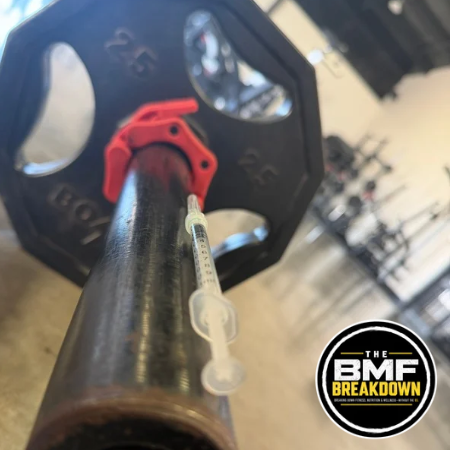
GLP-1 medications have completely changed the weight-loss conversation.
Ozempic. Wegovy. Zepbound. Mounjaro.
You’ve probably heard the names. You may know someone taking one. You may be taking one yourself.
And let’s make something clear right from the beginning: We’re not here to tell you whether you should or shouldn’t use a medication.
That’s a conversation between you and your qualified healthcare provider.
Our lane is fitness.
And from a fitness perspective, there’s an important part of the GLP-1 conversation that doesn’t get nearly enough attention:
When you’re losing weight, what are you doing to protect the muscle you want to keep?
Because losing weight and building a healthier, stronger body aren’t automatically the same thing.
Let’s break it down.
WEIGHT LOSS ISN’T ALWAYS JUST FAT LOSS
When body weight decreases, the weight lost doesn’t necessarily come exclusively from body fat.
Some lean tissue can also be lost during weight reduction.
That’s not a reason to panic or avoid weight loss when it’s medically appropriate. It’s a reason to think beyond the number on the scale.
If the goal is improved health and function, we’d generally like to preserve as much useful lean tissue as possible while reducing excess body fat.
That’s where exercise—particularly resistance training—becomes important.
WHY MUSCLE MATTERS
Muscle helps you move.
It helps you lift, carry, climb, push, pull, balance and perform everyday tasks.
It contributes to strength and physical function.
And if you’re somewhere between 35 and 65, maintaining muscle isn’t just about looking “toned.”
It’s about building a body you’re going to need for the next several decades.
So when someone is successfully losing significant amounts of body weight, we don’t want the entire conversation to be:
“Look how much the scale went down!”
We also want to ask:
Are you getting stronger? Are you maintaining muscle? Are you eating adequately? Are you moving well? Are you building habits that support the body you’re creating?
That’s a much bigger picture.
WHERE STRENGTH TRAINING FITS
Strength training gives your body a reason to hold onto muscle.
Squats. Hinges. Presses. Rows. Lunges. Carries. Core work.
The specific exercises can vary, but the message to the body is similar:
We still need this muscle.
And as you become stronger, your program should progressively challenge you.
That doesn’t mean every workout needs to be brutally hard. It means resistance training should be intentional—not an afterthought.
WHEN CALORIES COUNT THE MOST (AND SOMETIMES, EATING MORE IS THE ANSWER)
Your body needs fuel.
Your body has been working hard to lose weight; you’ve been working out – and more than likely you’ve been doing all of this while in a calorie deficit.
While on a GLP-1, if you begin to experience a decrease in energy, disrupted sleep, poor gym performance or stalled weight loss – the answer is usually NOT adding more medication or workouts – it is almost certain that it’s time to add more food.
How can eating more help you lose more? By providing the proper fuel in the proper quantity, it is almost like an insurance policy for your muscle mass. Your healthy, active metabolism relies on your calorie-burning lean mass: muscle!!
Understanding daily caloric and macronutrient needs (carbs, protein and fat) is crucial to continued weight loss success – while protecting your precious muscle mass.
LET’S BREAK DOWN THE BS: “I’M LOSING WEIGHT, SO MY PROGRAM IS WORKING”
Maybe.
But the scale alone can’t tell you the quality of that weight loss.
It can’t tell you whether you’re stronger.
It can’t tell you whether your cardiovascular fitness improved.
It can’t tell you whether you’re maintaining muscle.
It can’t tell you whether your balance or mobility improved.
It can’t tell you whether you’ve built habits you can maintain.
Weight is data. It isn’t the entire outcome.
PROTEIN BELONGS IN THIS CONVERSATION TOO
If you’re strength training and trying to preserve or build muscle, protein matters.
And for people taking medications that significantly reduce appetite, eating enough protein can sometimes require more intention.
That doesn’t mean living on protein shakes.
It means looking at your overall nutrition and making sure you’re providing your body with the building blocks it needs.
Your physician or registered dietitian can help with individualized nutrition needs—especially if medication side effects make eating difficult.
DON’T FORGET CARDIOVASCULAR FITNESS
Strength training matters.
So does your heart.
Walking, cycling, Spin, swimming, running, HIIT when appropriate and other forms of aerobic activity can help improve cardiovascular fitness.
The goal isn’t to use cardio as punishment for eating.
The goal is to build a body that is both strong and conditioned.
THE MEDICATION CAN’T BUILD YOUR HABITS FOR YOU
This may be one of the most important parts of the conversation.
Medication may help change appetite, food intake and body weight. But it doesn’t automatically teach you how to strength train.
It doesn’t create a consistent exercise routine.
It doesn’t teach you how to build balanced meals.
It doesn’t improve your squat technique.
It doesn’t establish a bedtime.
It doesn’t create a support system.
Those are skills and behaviors.
And those skills matter whether you use medication for six months, six years or indefinitely under your physician’s care.
WHAT SHOULD EXERCISE LOOK LIKE?
There’s no universal GLP-1 workout.
Your exercise program should reflect your health, fitness level, training history, goals and medical guidance.
For many adults, a balanced approach will include resistance training, cardiovascular exercise, mobility, regular everyday movement and adequate recovery.
Start where you are.
Then progress.
DON’T TRY TO “OUTWORK” YOUR WEIGHT LOSS
If your appetite is low and your energy intake has dropped significantly, suddenly adding seven intense workouts a week isn’t necessarily the smartest strategy.
More isn’t automatically better.
We want enough training stimulus to create positive adaptation without piling excessive stress onto a body that may already be adjusting to substantial changes.
Good coaching matters here.
THE FINAL BREAKDOWN
If you’re losing weight, don’t forget what you want to KEEP.
Muscle matters.
Strength matters.
Cardiovascular fitness matters.
Mobility matters.
Nutrition matters.
Habits matter.
A smaller body isn’t automatically a stronger body—and our goal should be bigger than simply making the number on the scale go down.
Use the tools available to you with appropriate medical guidance.
And while the medication does its job, you do yours.
Strength train. Prioritize nutrition and protein. Move your body. Recover. Build habits.
Because we’re not simply chasing weight loss.
We’re building a body that works.
WANT HELP BUILDING STRENGTH WHILE LOSING WEIGHT?
At BMF Fitness in Spring, Texas, we coach the person—not the medication they’re taking.
Whether your goal is fat loss, muscle gain, improved fitness or simply feeling stronger and more capable, we’ll help you build an exercise program that supports where you’re going.
Build muscle. Build fitness. Build habits.
Come as you are. We’ll help you build from there.
Start with a consult – book here now!
BETTER TOGETHER. BETTER EVERY DAY.

